
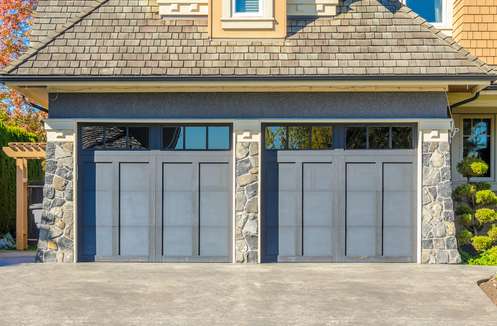
Garage door springs do almost all the heavy lifting every time your door opens and closes, and when they start to fail, things can go wrong very quickly. Recognizing the early warning signs can help you avoid getting trapped in your garage, damaging your opener, or, worst of all, having the full weight of the door come crashing down unexpectedly.
If you live in Fairview, Asheville, Hendersonville or the surrounding North Carolina mountain communities, keeping an eye on your springs is especially important because temperature swings and humidity can speed up wear and rust.
Worried your springs might be failing? Don't wait for a disaster. Schedule a professional safety inspection with Integrity Garage Doors today.
Why Garage Door Springs Matter So Much
Your garage door may weigh well over 150 pounds, but it feels "light" because the springs are doing the hard work of counterbalancing that weight. When a torsion or extension spring weakens or breaks, the opener is suddenly trying to move a door it was never designed to lift alone, which can burn out the motor and create a serious safety hazard.
That's why spring work is never a DIY project—springs are under extreme tension and can cause serious injury or property damage if handled incorrectly, a fact emphasized by the U.S. Consumer Product Safety Commission (CPSC).
Sign 1: A Loud Bang From the Garage
One of the most common complaints homeowners report is hearing a sudden loud "bang" or "snap" from the garage, even when nobody is using the door. That sound is often the moment a torsion spring breaks and releases its stored energy, leaving the door unsupported.
If you hear a noise like this and later notice the door isn't working right, assume the spring may have failed and stop using the door until it's inspected.
Image Suggestion: A close-up shot of a broken torsion spring with a visible gap in the coils.
Sign 2: The Door Won't Open (Or Only Moves a Few Inches)
If the opener runs but the door barely moves off the ground—or refuses to open at all—this is a classic sign of a broken or severely weakened spring. Most modern openers have a safety feature that stops or reverses the door if it senses too much resistance, which is what happens when the spring is no longer carrying the load.
Do not keep hitting the remote hoping it will "work itself out." Repeated attempts can strip gears in the opener or cause the door to bind and twist.
Sign 3: The Door Feels Extremely Heavy to Lift Manually
Garage doors with healthy springs can usually be lifted by hand with one arm because the springs balance most of the weight. If you pull the emergency release cord and the door suddenly feels like dead weight, there's a strong chance your springs are failing or already broken.
This is not the time to test your strength—forcing a heavy, unbalanced door can cause it to slam shut or come off the tracks altogether.
Sign 4: The Door Opens Crooked or Jerky
When one spring is carrying more load than the other, or when an extension spring is stretched or damaged, the door may rise unevenly or move in a jerky, shaky motion. You might notice one side of the door sitting higher, or the door binding and rubbing against the tracks.
Uneven operation puts extra stress on the rollers, hinges and opener, which can turn a simple spring repair into a much more expensive full-system repair if ignored.
Sign 5: The Door Slams Shut or Closes Too Fast
A properly balanced garage door should move in a smooth, controlled way and gently settle onto the floor. If your door starts dropping faster than normal, or even slams to the ground, that's a red-flag that the springs aren't providing enough counterbalance anymore.
This is a major safety issue for kids, pets and cars passing under the door—spring repair should be treated as an urgent problem, not a "someday" task.
Sign 6: Visible Gaps, Rust, or Stretching in the Springs
Sometimes the problem is visible to the naked eye:
-
A torsion spring with a clear gap between the coils.
-
Extension springs that look stretched out, sagging, or uneven.
-
Obvious rust or corrosion along the spring coils.
These signs, as noted by the International Door Association (IDA), usually mean the metal has already weakened and is at higher risk of snapping, especially in humid or changing weather conditions like those around Asheville and Hendersonville.
Image Suggestion: A photo showing a rusty and worn-out extension spring next to a new one for comparison.
Sign 7: Loose, Hanging, or Frayed Cables
Springs and cables work together as part of the same counterbalance system. When a spring fails, it can cause lift cables to go slack, hang loose, or even unwind from the drum near the top of the track.
If you see hanging cables, stop using the door and keep everyone clear of the opening. A mis-routed or tangled cable can cause the door to come off track or jam unexpectedly.
What to Do If You Notice These Warning Signs
If one or more of these symptoms sound familiar, here's the safest next step:
-
Stop using the door and opener until a technician has inspected the system.
-
Do not attempt DIY spring adjustment or replacement—the stored energy in springs can cause serious injuries.
-
Keep kids, pets, and cars clear of the opening and avoid standing directly under the door.
-
Call a licensed local expert who handles torsion and extension spring replacement every day.
For homeowners in Fairview, Asheville, Hendersonville, Lake Lure and nearby areas, Integrity Garage Doors provides same-day garage door spring replacement with licensed, insured technicians.
Frequently Asked Questions (FAQ)
Q: How long do garage door springs last?
A: Most standard garage door springs are rated for about 10,000 cycles (one cycle is one open and close). If you use your door 3-4 times a day, this typically translates to a lifespan of 7-9 years. High-cycle springs are also available that can last much longer.
Q: What is the difference between torsion and extension springs?
A: Torsion springs are large springs mounted on a metal bar above the garage door opening. Extension springs are smaller and run along the sides of the upper garage door tracks. Torsion springs are generally considered safer and more durable.
Q: How much does spring replacement cost in the Asheville area?
A: The cost can vary depending on the type of spring, the size and weight of your door, and whether one or both springs need to be replaced. It is always best to request a precise estimate for your specific situation.
Why Asheville & Hendersonville Homeowners Trust Integrity for Spring Repair
Integrity Garage Doors is a local, family-owned company based in Fairview and serving the greater Asheville and Henderson counties, with 24/7 availability for urgent spring and repair calls.
The team handles everything from broken torsion springs and off-track doors to opener issues and full garage door replacement and repairs in Asheville, NC.
You can explore recent local projects in our garage door installation gallery and see how new doors and properly balanced springs improve safety, curb appeal, and day-to-day convenience.
Ready to Have Your Springs Checked?
If you think your garage door springs might be close to failing—or you've already noticed one of the warning signs above—don't wait for the door to fail at the worst possible moment.
-
Learn more about garage door spring replacement in Fairview, Asheville and Hendersonville.
-
Or request an estimate through our contact page and get a licensed technician scheduled.
Catching spring problems early is one of the simplest ways to protect your family, your vehicles, and your opener—while keeping your garage door running smoothly for years to come.